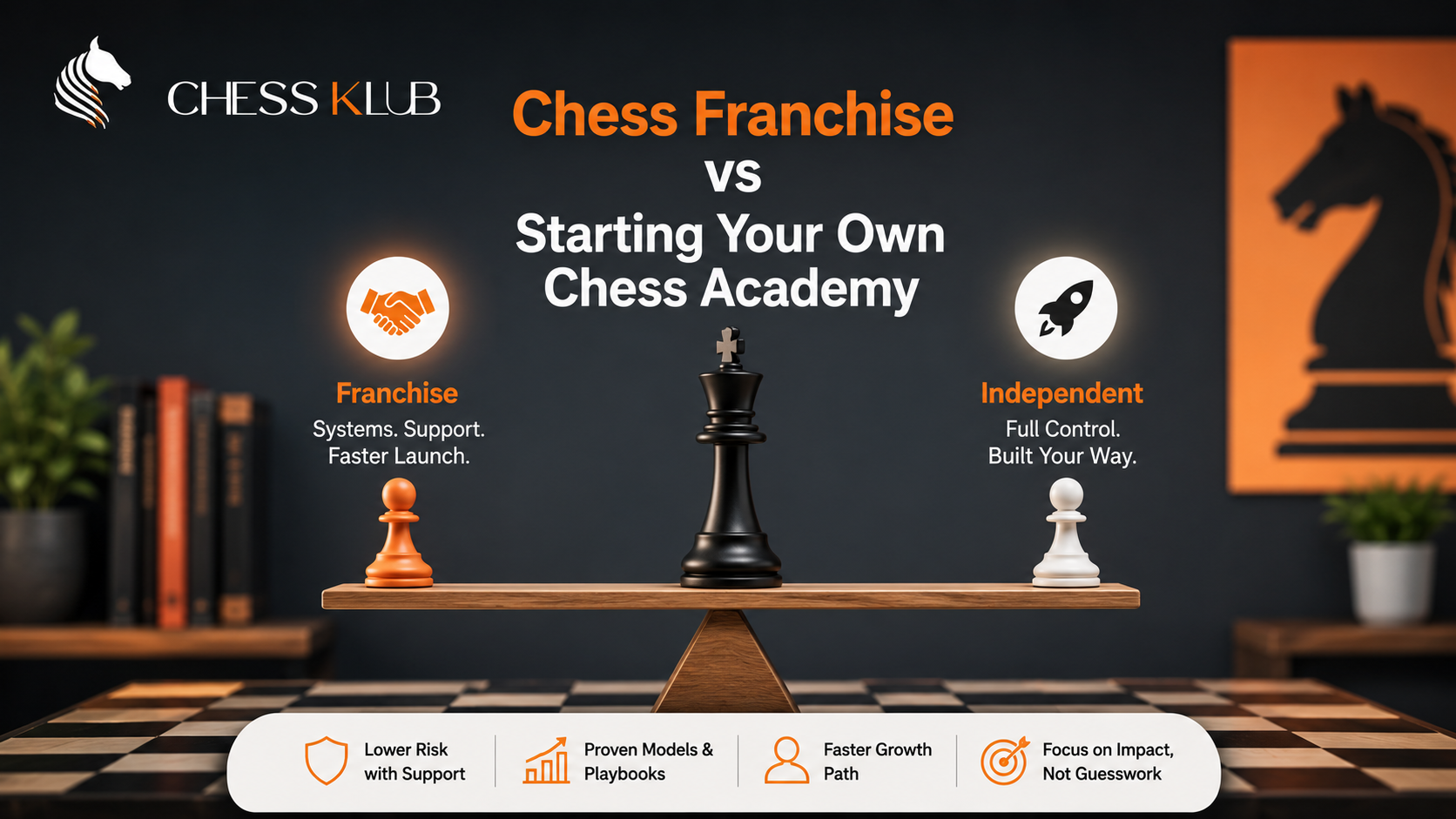
Chess Franchise vs Starting Your Own Chess Academy: An Honest Comparison
Key Takeaways
- Going independent gives you full control but requires solving curriculum, coaching, marketing, and branding entirely on your own — a considerable challenge if you're new to the education business.
- A chess franchise gives you a tested model, brand recognition, and operational support from day one — in exchange for a franchise fee and brand compliance.
- Neither path is inherently better — the right choice depends on your background, capital, and risk tolerance.
- The hidden costs of going independent (curriculum development, coach turnover, failed marketing) often exceed the cost of a franchise fee.
- Most independent chess academies that fail do so not because of chess — but because of business problems that a good franchise model is specifically designed to prevent.
If you're seriously thinking about opening a chess academy in India in 2026, you will eventually arrive at this question: do I build something from scratch, or do I join an established brand?
It's a fair question, and it deserves a fair answer — not a sales pitch from either direction. This article gives you both sides honestly, so you can make the right decision for your situation.
What 'Going Independent' Actually Means
Starting an independent chess academy means building everything yourself: the brand, the curriculum, the coaching team, the marketing, the operations, the student management software, the tournament network, and the parent communication process. Every one of these is a separate problem to solve — and you're solving all of them simultaneously, often while also trying to teach chess or manage a center full of children.
This is not impossible. Some of India's finest chess academies — Chess Gurukul, run by GM R.B. Ramesh, and Chess Gurukul's successors — were built this way, through years of effort by chess professionals who understood both the game and the teaching deeply. But these are the exceptions. They are built by people with rare combinations of chess expertise, business sense, and extreme patience.
For most people considering opening a chess academy — especially those without a chess professional background — the independent path involves a steep, expensive, and often lonely learning curve.
What a Chess Franchise Actually Gives You
A chess franchise is not just a brand name and a logo. A well-structured franchise — and the word 'well-structured' matters here — gives you a set of already-solved problems:
- A curriculum that has been developed, tested, and refined across hundreds or thousands of students — so you're not inventing a syllabus from scratch
- Coach training and hiring support — the most consistently underestimated operational challenge for independent academies
- A marketing playbook that includes digital advertising templates, student acquisition strategies, and brand assets
- A technology stack — student management, scheduling, payment processing, and progress tracking systems
- Brand recognition — parents choosing between an academy they've heard of and one they haven't will almost always call the familiar name first
- A network of other franchise owners to learn from — people who've solved the same problems you're about to face
The Honest Side-by-Side
Honest side-by-side comparison for 2026 operators
| What you need to figure out | Independent Academy | Chess Franchise (e.g. CHESS KLUB) |
|---|---|---|
| Curriculum | Build from scratch — 6–12 months minimum | Provided and tested across 30+ centers |
| Coach hiring & training | Recruit independently; high turnover risk | Supported — coach network and training provided |
| Brand recognition | None at launch — built over years | Established — parents recognise the name |
| Marketing | Self-funded and self-managed | Playbook and support provided |
| Tournament network | Build relationships independently | Access to existing tournament network |
| Technology & operations | Build or buy independently | Provided as part of the franchise system |
| Initial investment | Lower apparent cost; higher hidden costs | Franchise fee + setup; clearer total picture |
| Profit margin (long term) | Higher if successful — no royalty | Lower margin; royalty applies |
| Break-even timeline | 18–36 months typically | 8–12 months with a strong franchise |
| Territory protection | None — anyone can open nearby | Exclusive territory rights |
| Risk of failure | Higher — especially in first 2 years | Lower — proven model reduces key risks |
The Hidden Costs of Going Independent
The franchise fee is visible. The costs of going independent are often invisible until you're in the middle of them. Here are the three most common ones:
1. Curriculum development time: Building a structured chess curriculum takes longer than most people expect. You're not just deciding what to teach — you're sequencing it, creating materials, testing it with real students, revising based on what doesn't work, and then training coaches to deliver it consistently. This is a 6–12 month project at minimum, and during that time you're also trying to run a business. Independent academies that skip this step often end up with inconsistent teaching quality, which leads to student churn.
2. Coach turnover cost: When a coach leaves an independent academy, they often take their students with them. This is a structural problem, not a people problem. If your academy's value proposition is tied to a specific coach rather than a brand and curriculum, you are one resignation away from a significant revenue loss. Factoring in the cost of recruiting a replacement, re-earning parent trust, and the months of reduced enrollment during the transition — coach turnover is one of the most expensive events in an independent academy's lifecycle.
3. Marketing spend with no playbook: Marketing a new, unknown chess academy is genuinely hard. Parents searching for chess coaching in their city will find established brands first — on Google, on social media, through word of mouth. Building that presence from zero requires consistent, skilled marketing effort over 12–24 months. Many independent academies underspend on marketing during this critical period, which limits their enrollment growth and prolongs their path to break-even.
When Going Independent Makes Sense
The independent path is the right choice if:
- You are a FIDE-titled chess professional with deep coaching experience, an existing student base, and a strong local network. You are essentially commercialising something you've already built.
- You have significant startup capital, a business background, and at least 2–3 years of runway to build the brand before expecting profitability.
- You have a specific niche — an elite competitive academy, a school-partnership specialist, a specific demographic focus — that a franchise model doesn't serve.
- You want complete creative and operational control, and you're willing to pay for it in time and risk.
When a Franchise Makes Sense
A chess franchise is the right choice if:
- You are a business-minded entrepreneur who wants to enter the chess education space but doesn't have a professional chess background.
- You want a structured, proven model with a shorter break-even timeline and lower risk of the common failure modes described above.
- You value brand recognition and the ability to charge premium pricing from day one.
- You want the support of a network — other franchise owners, a founding team with operational experience, and ongoing coaching and curriculum updates.
The honest bottom line
CHESS KLUB's franchise model was built specifically for entrepreneurs who want to enter the chess education business with a tested system behind them. With 30+ centers across India and the United States, a six-level curriculum, FIDE-rated coaching staff, and an 8–12 month typical break-even — it addresses the most common failure points of the independent path. Explore the full details at franchise.chessklub.in.
About the Author
This article was written by the CHESS KLUB team. CHESS KLUB is India's largest chess education franchise network, with 30+ centers across India and the United States.