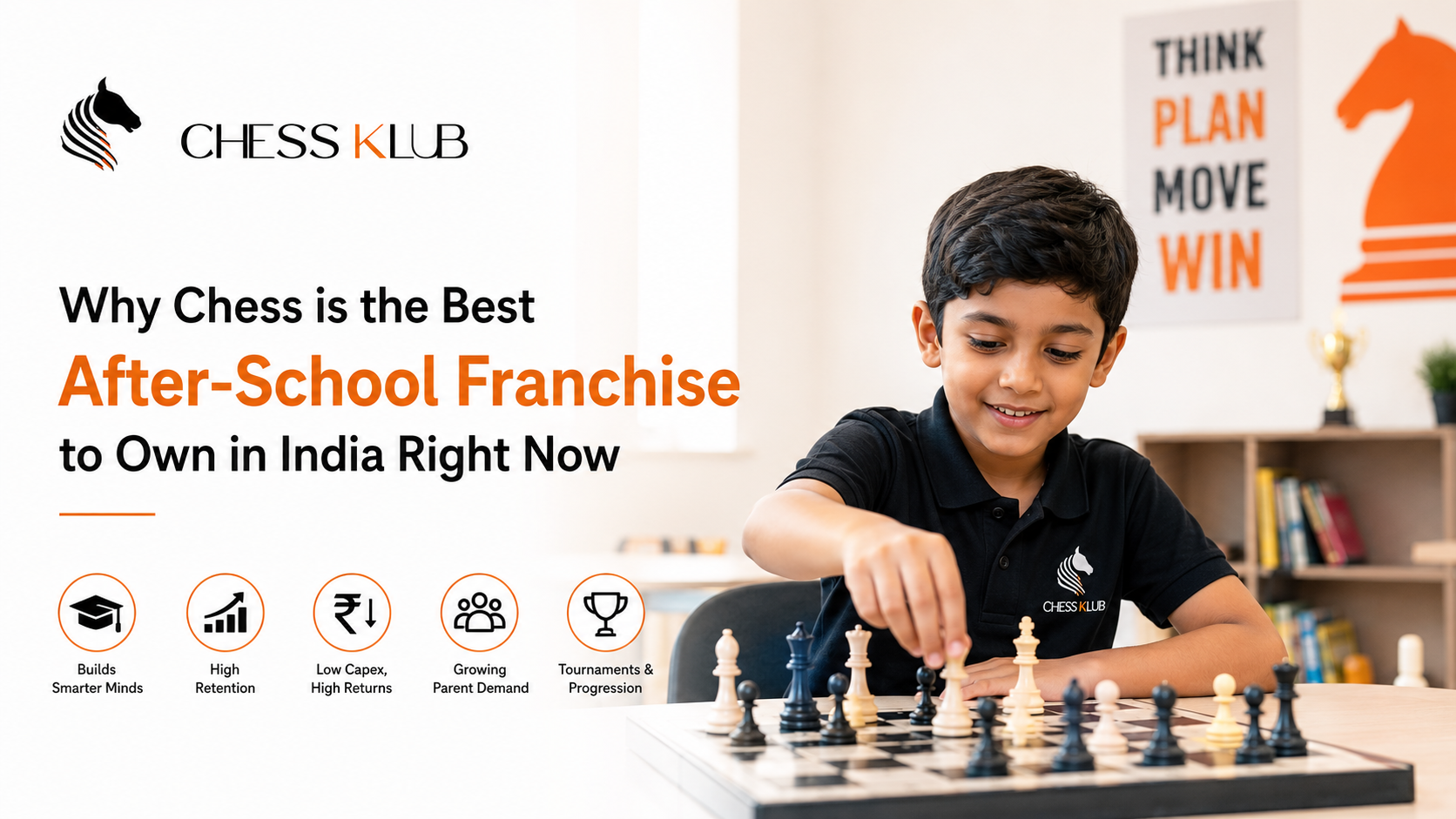
Why Chess is the Best After-School Franchise to Own in India Right Now
Key Takeaways
- India's after-school enrichment market is booming, but not all categories are equal — chess offers advantages that most other franchises cannot match.
- Chess has the longest student lifecycle of any after-school enrichment category — children can progress continuously from age 5 through their teens.
- The 2024–2026 chess boom in India has created a once-in-a-generation demand surge that is still building, not fading.
- Chess requires significantly less infrastructure than sports, robotics, or arts franchises — lower overhead means faster break-even.
- Research confirms that chess delivers measurable cognitive benefits — making it easy for parents to justify the investment, which reduces the hardest part of the sales process.
If you're evaluating after-school enrichment franchise opportunities in India, you're looking at a large and growing market. The Indian education sector is on its way to $225 billion by 2026. Parents are spending more on their children's development outside school hours than any previous generation. The opportunity is real across multiple categories — coding, robotics, abacus, music, football, chess.
But not all after-school franchises are built the same. Some are better businesses than others, and the differences matter when you're putting your capital and your next few years on the line. Here is the honest case for why chess — and specifically a CHESS KLUB franchise — stands out.
1. Chess Has the Longest Student Lifecycle of Any Enrichment Category
Most after-school enrichment programs have a natural endpoint. A robotics course has a curriculum that runs for one or two years. An abacus program graduates students after completing levels. Art and music lessons plateau for many children in early adolescence. Each of these creates a churn event — a natural exit point where parents and students reconsider whether to continue.
Chess has no natural exit point. The game has an essentially unlimited depth — grandmasters who have played for 40 years still find new things to learn. A child who joins a chess academy at age 5 can still be improving, competing, and engaged at age 17. That's a 12-year potential enrollment lifecycle.
At ₹2,000 per month, a student enrolled for 3 years generates ₹72,000 in revenue. A student enrolled for 8 years generates ₹1,92,000. No other after-school enrichment category in India offers this kind of customer lifetime value per student.
2. India's Chess Moment Has Created Demand That Did Not Exist Before
The timing of this article — June 2026 — puts it in the middle of what may be the most significant period in Indian chess history. In 2024, Gukesh D became the youngest-ever undisputed World Chess Champion. India won double gold at the FIDE Chess Olympiad. As of 2026, four Indian players rank in the world's top 20. India has 85+ Grandmasters — more per decade than any previous generation.
This has done something profound to parent behavior. Chess has moved from a hobby associated with a specific type of child to a mainstream aspiration — the way cricket became a national obsession in the 1980s, or how badminton surged after Saina Nehwal's 2012 Olympic bronze. Parents who couldn't name a chess opening are enrolling their children in coaching. Schools are introducing chess as an extracurricular. Coaching academies have waiting lists.
This kind of cultural shift — when a sport or activity crosses from niche to mainstream — creates a demand surge that is both large and durable. The academies and franchises that capture students during this surge build enrollment bases that compound for years. The window for early entry is now.
3. Chess Requires Less Infrastructure Than Almost Any Other Enrichment Category
Compare what you need to run a football academy versus a chess academy. Football requires a field, goalposts, balls, coaching equipment, insurance for outdoor activity, and a location where parents are comfortable with their children playing physically. A dedicated football facility in an urban area is a significant capital commitment.
A chess academy needs a room, chairs, chess boards, and a qualified coach. The same 500 sq ft classroom that rents for ₹8,000–₹12,000 per month in a Bengaluru residential area can comfortably accommodate 10–15 students in a group class. There is no specialized equipment requirement, no facility maintenance burden, no weather dependency, and no physical injury risk. The infrastructure simplicity of chess translates directly into lower overhead and faster break-even.
After-School Franchise Categories: A Comparison
After-school options compared on owner economics
| Category | Setup Cost | Monthly Overhead | Student Lifecycle | Break-even | Demand Trajectory |
|---|---|---|---|---|---|
| Chess | Low | Low | Very Long (5–12 yrs) | 8–18 months | Surging ↑ |
| Abacus / Mental Maths | Low | Low | Medium (2–3 yrs) | 12–24 months | Stable → |
| Coding / Robotics | Medium–High | Medium | Medium (2–4 yrs) | 12–24 months | Growing ↑ |
| Football / Sports | High | High | Long (5–10 yrs) | 24–36 months | Growing ↑ |
| Music / Arts | Medium | Medium | Variable | 18–36 months | Stable → |
| Preschool / Early Learning | High | High | Short (2–3 yrs) | 24–36 months | Stable → |
This table shows industry-level patterns. Individual franchise performance depends on brand, support quality, and operator. Data compiled from education franchise industry reports, FDD analysis, and operator surveys 2025–2026.
4. The Science Makes It Easy to Sell
Every parent who considers enrolling their child in chess coaching asks the same question: is this worth it? The answer, backed by peer-reviewed research, is unambiguous — and that research makes your sales process significantly easier than it would be for almost any other enrichment category.
A 2025 study published in Frontiers in Psychology found significant improvements in attention, memory, logical thinking, patience, self-discipline, mathematics scores, and reading scores among children who received chess training (p < 0.001). A meta-analysis covering 24 studies and 40 effect sizes confirmed that chess enhances primary and middle school students' achievement in mathematics and overall cognitive ability.
These are not chess club promotional claims — they are peer-reviewed, published findings from independent researchers. When a parent asks you 'why chess?', you have a compelling, evidence-backed answer. This dramatically lowers the first conversion barrier in your business.
For supporting research on cognitive outcomes, see Frontiers in Psychology.
5. Chess Has Unusually High Student Retention
Education franchises that focus on cognitive and structural skill-building — rather than pure academic remediation — consistently outperform remedial tutoring on student retention. A child who improves in maths tutoring no longer needs it; a child who improves at chess wants to keep improving.
Chess has an additional retention driver that few other enrichment categories can match: competition. Once a child competes in their first chess tournament, they are invested in improving. They want to beat the player who beat them last time. This competitive drive — healthy, constructive, and skill-building — is self-sustaining in a way that no amount of marketing can replicate.
CHESS KLUB's franchise model specifically leverages this through a tournament network that gives students regular competitive opportunities — from center-level open tournaments to larger inter-center events. Every tournament is a retention mechanism as much as it is a chess competition.
The bottom line on chess as a franchise category
CHESS KLUB is India's largest chess education franchise network, with 30+ centers across India and the United States. The franchise model is built to capture everything described in this article — the demand, the retention, and the long student lifecycle — with a tested curriculum, coach support, and a marketing playbook that has already been proven across three dozen centers. Learn more at franchise.chessklub.in.
About the Author
This article was written by the CHESS KLUB team. CHESS KLUB is India's largest chess education franchise network, with 30+ centers across India and the United States.